What does it take to turn a sheet of PET plastic into a precision-engineered food container that meets international safety standards? At HGF Factory in Wuhan, China, the journey from concept to finished product involves a carefully orchestrated sequence of design, tooling, forming, inspection, and logistics. Here is a closer look at each stage of that process.
Table of Contents
ToggleStep 1: Design and Engineering
Every packaging project begins with a conversation. HGF Factory’s engineering team works closely with clients to understand their product requirements, retail display needs, shelf-life targets, and brand identity. Using advanced 3D CAD software, the team develops detailed digital models of proposed container designs, analyzing wall thickness distribution, hinge mechanics, sealing surfaces, and stackability before any material is cut.
This collaborative design phase is critical. A well-engineered container not only looks right on the shelf but also minimizes material usage, reduces thermoforming cycle times, and ensures reliable performance throughout the cold chain. For clients who are unsure about specifications, HGF Factory offers a complimentary design consultation service that draws on years of experience serving fresh produce, bakery, and deli markets worldwide.
Design-to-Tooling Timeline: HGF Factory typically completes the design approval and moves to mold fabrication within 2 to 3 weeks of final design sign-off, significantly faster than the industry average of 6 to 8 weeks.
Step 2: CNC Mold Making
The mold is the heart of the thermoforming process, and HGF Factory’s in-house CNC machining center is the foundation of its quality advantage. Using high-precision CNC milling machines, the company fabricates aluminum and steel molds directly from the approved 3D models. This vertical integration eliminates the delays and quality variability associated with outsourcing tooling.
HGF Factory’s mold-making capabilities include:
- 5-axis CNC machining for complex geometries such as hinged clamshells and multi-compartment containers
- EDM (Electrical Discharge Machining) for fine surface finishes and intricate detail features
- CAD/CAM programming that ensures mold cavities match design specifications within tolerances of plus or minus 0.05mm
- Rapid prototyping using soft aluminum molds for client testing before committing to production-grade tooling
3D Design and Simulation
Digital modeling and thermoforming simulation to optimize wall thickness, material flow, and structural integrity before tooling begins.
CNC Mold Fabrication
Precision machining of aluminum or steel molds in-house, with 5-axis milling and EDM finishing for tight tolerances.
Sheet Extrusion and Feeding
PET or RPET resin pellets are extruded into uniform sheets, temperature-controlled, and fed into thermoforming lines with consistent tension.
Thermoforming
Heated PET sheets are shaped in precision molds using vacuum and compressed air. Cycle times are optimized for each container geometry.
Trimming and Finishing
Automated die-cutting separates individual containers from the formed sheet. Edges are cleanly trimmed for safe handling and consistent dimensions.
Quality Inspection and Packing
Automated vision systems and manual sampling ensure every batch meets dimensional, cosmetic, and food-safety specifications before packing for shipment.
Step 3: Thermoforming Production
HGF Factory operates multiple thermoforming lines capable of processing PET sheets ranging from 0.2mm to 1.5mm in thickness. Each line is equipped with multi-zone heating systems that provide precise temperature control across the sheet surface, preventing hot spots and cold spots that could cause inconsistent wall thickness or surface blemishes.
During thermoforming, the heated PET sheet is draped over or plugged into the mold cavity, and a combination of vacuum pressure and positive air pressure forces the material to conform to the mold surface. The formed sheet is then cooled rapidly to lock in the container shape. Modern servo-driven trimming stations separate individual containers with clean, burr-free edges at high speed.
Step 4: Automated Quality Control
Quality is not a single checkpoint at HGF Factory; it is embedded throughout the production line. Automated vision inspection systems scan every formed sheet for dimensional accuracy, surface defects, and wall thickness consistency. Containers that fall outside tolerance are automatically diverted.
Beyond automated systems, HGF Factory maintains a dedicated quality assurance laboratory where technicians conduct:
- Dimensional verification using calibrated gauges and coordinate measuring machines (CMM)
- Drop and compression testing to validate stack strength and impact resistance under simulated shipping conditions
- Seal integrity testing for lidded containers to ensure reliable closure during transportation
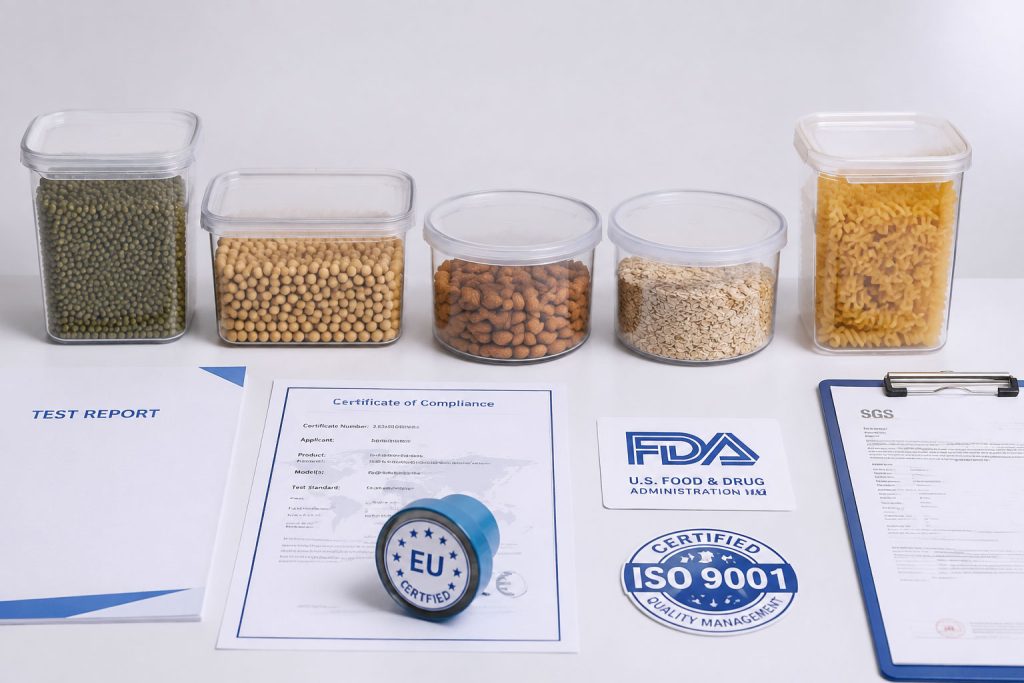
- Food-contact migration testing conducted in partnership with accredited third-party laboratories
Step 5: Packaging and Logistics
Finished containers are counted, nested, and packed into corrugated shipping cartons designed for efficient container loading. HGF Factory’s packaging engineers optimize carton dimensions to maximize container density in 20-foot and 40-foot shipping containers, reducing per-unit logistics costs for overseas clients. Each carton is labeled with batch numbers, production dates, and certification references for full traceability from factory floor to client warehouse.
Conclusion
The journey from raw PET resin to a retail-ready food container involves dozens of precisely controlled steps. HGF Factory’s investment in in-house tooling, advanced thermoforming equipment, automated inspection systems, and rigorous laboratory testing ensures that every container that leaves our Wuhan facility meets the performance, safety, and aesthetic standards that our clients and their customers expect.