


For importers sourcing food-contact packaging from international manufacturers, navigating the web of global standards is essential. A container that passes inspection in one market may face rejection in another. This guide explains the major regulatory frameworks that govern food-contact packaging and outlines what importers should verify before placing orders.
Why Standards Matter for Importers
Food-contact packaging regulations exist to protect consumers from chemical migration, physical contamination, and allergen exposure. Each major market has developed its own regulatory framework, and while there is significant overlap in their requirements, the testing methods, documentation standards, and approval processes differ. For importers, a failure to understand these differences can result in shipment holds at customs, costly product recalls, or liability exposure.
The good news is that a well-managed packaging manufacturer can provide the certifications and documentation you need to clear customs and satisfy retail compliance audits. The key is knowing what to ask for.
The Major Regulatory Frameworks
United States: FDA 21 CFR
The U.S. Food and Drug Administration regulates food-contact packaging under Title 21 of the Code of Federal Regulations (21 CFR), specifically Parts 170 through 199. For PET packaging, the most relevant sections are 21 CFR 177.1630 (polyethylene phthalate) and 21 CFR 170.39 (threshold of regulation exemptions).
- Notification requirement: Manufacturers must ensure that all components of the packaging comply with applicable FDA regulations. While pre-market approval is not required for most food-contact materials, manufacturers must maintain supporting documentation.
- Migration testing: FDA-compliant packaging must pass extraction testing to verify that chemical migration levels stay below established thresholds. Testing is typically conducted using food simulants under specified temperature and time conditions.
- Letter of No Objection (LNO): For novel materials or recycled content, manufacturers may seek an FDA LNO, which provides regulatory assurance that the agency has reviewed the safety data and has no objection to the proposed use.
- Documentation to request: FDA compliance letter, migration test reports from accredited laboratories, and material composition declarations.
European Union: Framework Regulation (EC) No 1935/2004
The EU food-contact materials framework is among the most comprehensive in the world. Regulation (EC) No 1935/2004 establishes the overarching principles, while specific materials are covered by delegated regulations. For plastics, Regulation (EU) No 10/2011 (the ‘Plastics Regulation’) is the primary standard.
- Positive list system: Unlike the FDA’s approach, the EU uses a positive list of authorized substances. Only chemicals explicitly listed in Annex I of Regulation 10/2011 may be used in plastic food-contact materials.
- Overall migration limit (OML): Total migration from all substances combined must not exceed 10 mg/dm² across all food simulants.
- Specific migration limits (SML): Individual substances have their own migration thresholds, some of which are extremely restrictive (as low as 0.002 mg/kg for certain substances).
- Declaration of compliance: EU law requires a formal declaration of compliance that travels with the packaging through the supply chain, documenting material composition and test results.
- Documentation to request: EU Declaration of Compliance, specific and overall migration test results, material composition list, and EFSA opinions where applicable.
International: ISO 9001 and ISO 22000
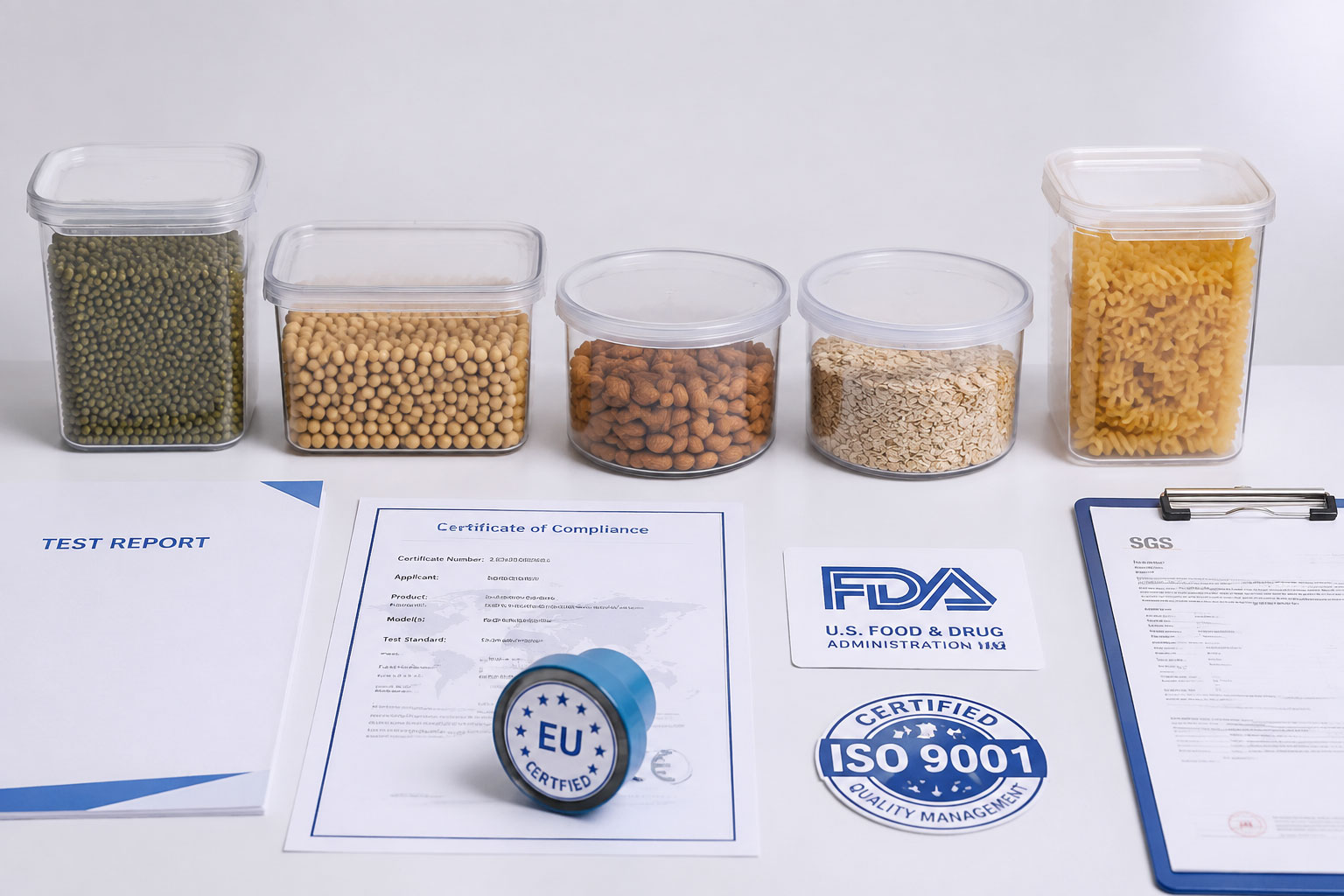
While ISO standards are not regulations per se, they are widely accepted as evidence of quality management and food safety competence. Many retailers and importers require their packaging suppliers to hold specific ISO certifications as a prerequisite for doing business.
- ISO 9001:2015 certifies that the manufacturer operates a documented quality management system with defined processes for design, production, inspection, and continuous improvement.
- ISO 22000:2018 extends quality management into food safety, covering hazard analysis, prerequisite programs, and management system requirements specific to the food supply chain.
- Documentation to request: Valid ISO 9001 and/or ISO 22000 certificates issued by an accredited certification body, along with the scope of certification covering food-contact packaging manufacturing.
China: GB 4806 Series and GB 9685
China’s food-contact materials are regulated under the GB 4806 series of national standards, with GB 9685 providing the general rules for the use of additives. These standards are aligned with Codex Alimentarius principles but have distinct requirements that apply to manufacturers producing in China for both domestic and export markets.
- GB 4806.6-2016 covers plastic resins for food contact, including PET specifications.
- GB 4806.7-2016 addresses plastic articles for food contact, including finished containers.
- GB 31604 series specifies migration testing methods used in Chinese compliance evaluations.
- Documentation to request: GB compliance test reports, Chinese food contact material safety certificates, and production license documentation.
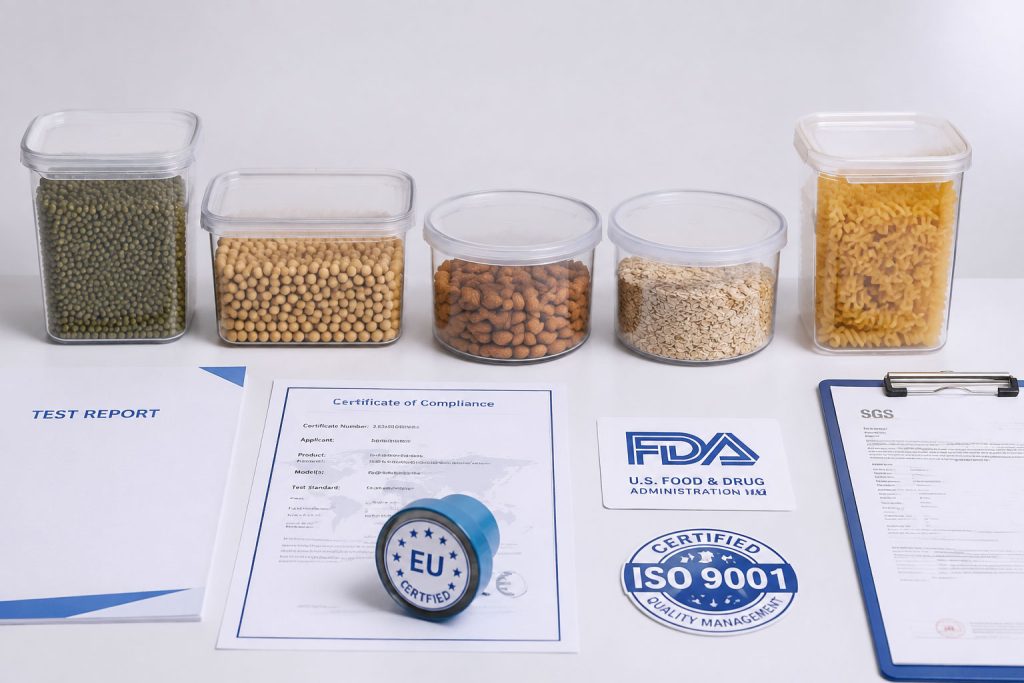
HGF Factory Compliance Profile: As a Wuhan-based manufacturer serving international markets, HGF Factory maintains certifications across all major regulatory frameworks. Our compliance portfolio includes ISO 9001:2015, FDA 21 CFR compliance documentation, EU Regulation 10/2011 Declaration of Compliance, and GB 4806 certification. We provide full documentation packages with every shipment to support customs clearance and retail compliance audits.
Practical Tips for Importers
Navigating global standards does not have to be overwhelming. Here are practical steps that importers can take to ensure compliance at every stage of the sourcing process.
Supplier Compliance Checklist
Emerging Regulatory Trends
Food-contact packaging regulations are evolving rapidly. Several trends are worth monitoring for importers planning long-term sourcing strategies:
- PFAS restrictions: Multiple jurisdictions are moving to ban or restrict per- and polyfluoroalkyl substances (PFAS) in food-contact materials. PET is inherently PFAS-free, making it a future-proof choice.
- Mandatory recycled content: The EU, UK, and several U.S. states are implementing minimum recycled content requirements for plastic food packaging. Sourcing from suppliers with RPET capability ensures readiness.
- Digital product passports: The EU is developing digital product passport requirements that will eventually cover packaging, requiring detailed material and sustainability data to accompany products through the supply chain.
- Extended producer responsibility (EPR): More countries are implementing EPR schemes that hold producers financially responsible for end-of-life packaging management. Choosing highly recyclable materials like PET reduces EPR fee exposure.
Conclusion
Compliance with global food-contact packaging standards is both a legal obligation and a competitive advantage. Importers who invest in understanding these frameworks and partner with certified manufacturers protect their businesses from regulatory risk while demonstrating commitment to consumer safety. HGF Factory is dedicated to helping our clients navigate these requirements with full transparency, comprehensive documentation, and manufacturing standards that meet the world’s most stringent food safety expectations.